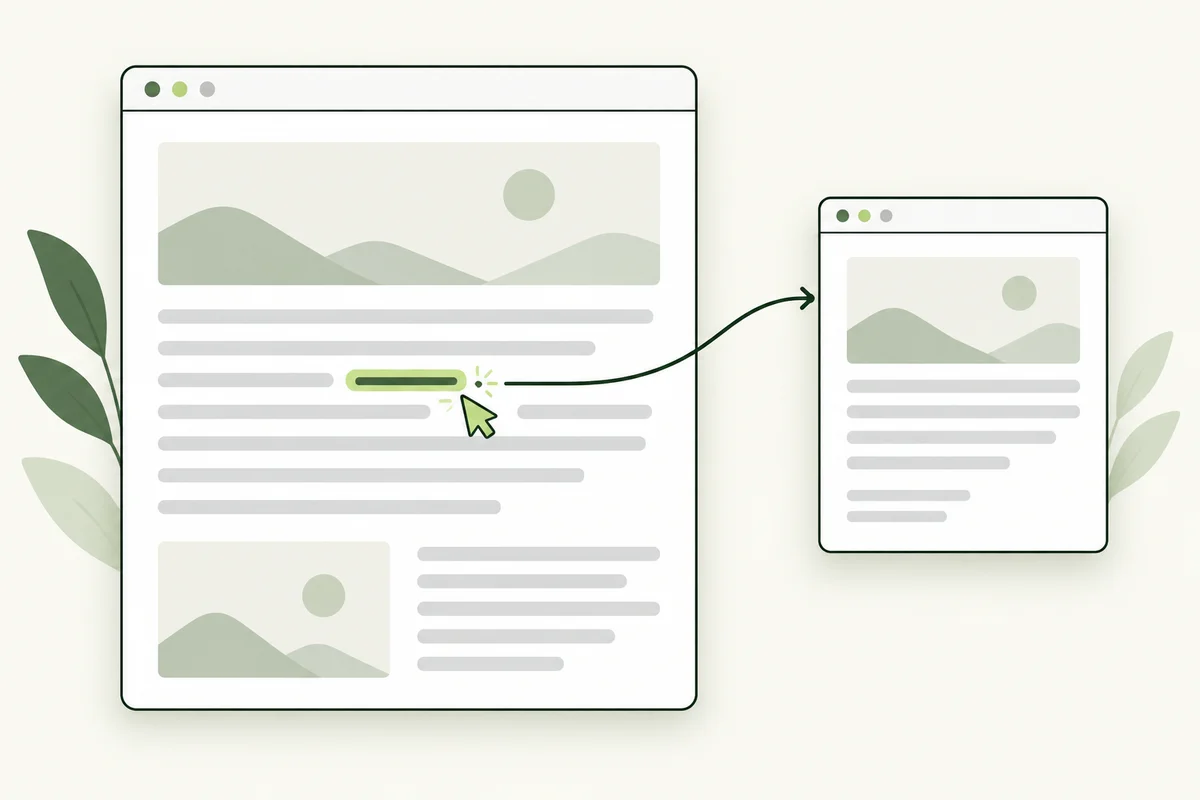
The words you click in a link are called anchor text. Before you follow a link, those words should give you a reasonable idea of what comes next: a price list, a service explanation or perhaps a contact form.
This guide focuses on choosing the words. For planning which pages should connect within your website, see our internal linking guide.
Start with the destination’s purpose
Open the destination before writing the link. Is it a product specification, a pricing comparison, a preparation guide or a contact form? Describe the information actually available there. A link promising installation instructions should not lead to a general homepage where the visitor must search again.
For example, a supplier, “view cabinet dimensions” would fit a specification page. “Request a cabinet quotation” would fit an enquiry form. Both relate to the same product, but they set different expectations.
Recognise common wording choices
- Brand wording: the business or publication name, useful when identifying the source.
- Descriptive wording: a phrase explaining the destination, such as “office moving checklist”.
- A visible URL: useful when the address itself matters, but often less readable in a paragraph.
- Generic wording: phrases such as “click here”, which give little information on their own.
These are editing choices, not categories that need a fixed percentage allocation. Choose wording that suits the sentence and the reader’s immediate question.
Keep the sentence natural
Read the sentence with the link included. If it sounds like a list of search phrases, rewrite it. You can mention a service clearly without inserting every location, variation and promotional claim into the clickable text.
Google’s link guidance recommends descriptive, concise wording that fits both the source and destination. It also highlights the importance of the surrounding context. Give readers enough explanation to understand why you are pointing them elsewhere.
Review external links in context
When another publisher links to your website, the wording may use your brand, a descriptive phrase or another natural reference. An exact copy of your target keyword is not the only useful way to identify the destination. Do not judge a placement solely by whether one phrase appears in the anchor.
Check the article’s meaning, the destination and the wording together. Link relationship labels are a separate issue; our nofollow and sponsored links guide explains those labels.
A short editing checklist
- Can someone predict the destination from the link wording?
- Does the destination fulfil that expectation?
- Does the phrase fit naturally into the sentence?
- Could a shorter phrase communicate the same information?
- Is the surrounding explanation useful without repeating the link?
When reviewing a campaign, record a specific mismatch rather than asking for every link to use identical wording. Our monthly backlink report guide explains how to review published placements as a whole.